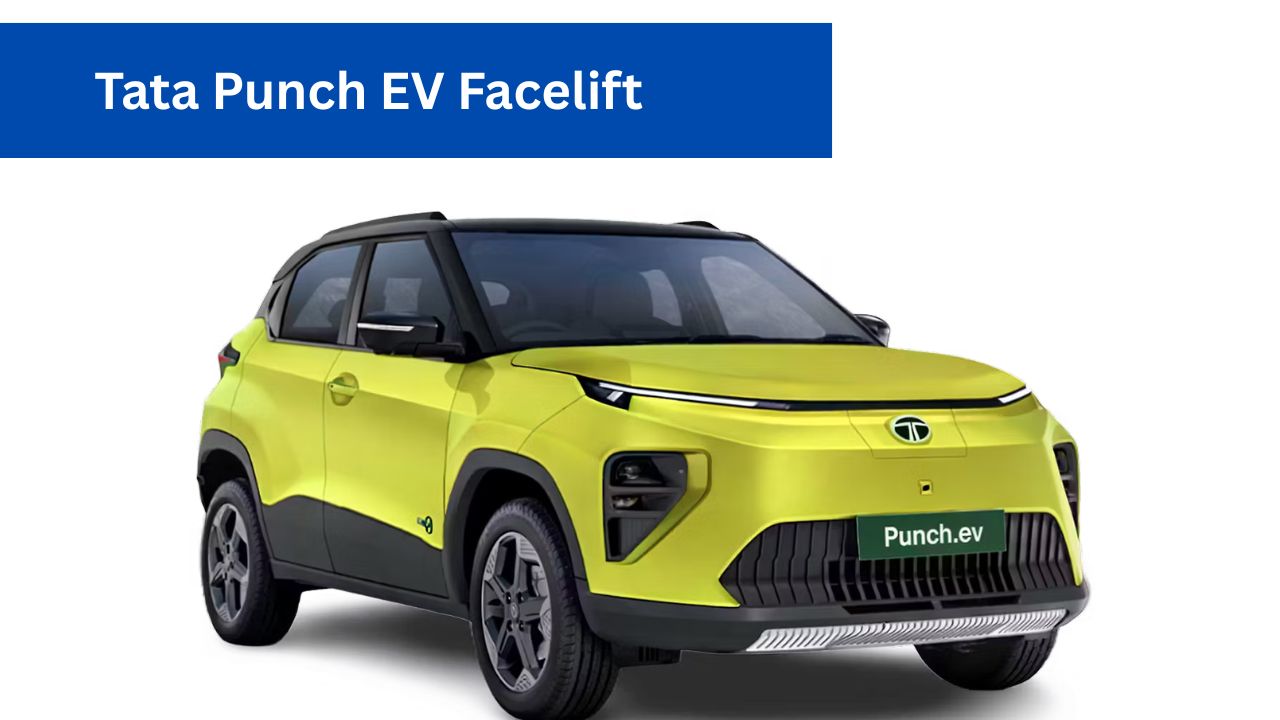
Tata Punch EV Facelift: India’s electric vehicle market is about to undergo a big transformation. Tata Punch EV Facelift is scheduled to be released on February 20, 2026; the buzz around this upgrade has been growing for weeks. Since it was first introduced in early 2024, the Punch EV has been instrumental in democratizing electric mobility as the company’s least expensive electric SUV.
Tata Motors is rejuvenating it now, two years later, with significant design, technology, and powertrain changes meant to maintain it at the top of its game in India’s always more cutthroat entry-level EV sector.
This article lists the top 5 facts you should know about the Tata Punch EV Facelift before its official debut tomorrow, whether you are a prospective purchaser, an EV aficionado, or just interested to learn about where India’s EV business is going.
1. Bold New Exterior Design: A Fresher, More Modern Look
The exterior makeover of the Tata Punch EV Facelift is among the most obvious alterations. Although the upgrade is incremental rather than revolutionary, the changes are significant enough to give the small electric SUV a more luxurious, modern appearance that fits well with Tata’s more recent portfolio.
Its character as a pure electric vehicle is reinforced at the front by a facelift with a closed-off grille on a reimagined bumper. Removing the black trim piece that once joined the headlights on the older model yields a tidier, more elegant front fascia. The Punch EV now has a sharper and more intentional attitude thanks to modern LED DRL signatures and neat triangular pods holding its headlights.
Given how well-proportioned the current design already is, one may understand that the whole shape stays mostly unaltered on the sides. But Tata has added a dash of sportiness and enhanced aerodynamic efficiency by means of new aero-optimized alloy wheels modeled after those found on the bigger Nexon EV.
One of its most important visual changes at the back, the Punch EV Facelift, has connected LED tail-lamps that stretch the width of the vehicle, in keeping with what we have seen on the refreshed ICE model. This one adjustment greatly transforms the rear end and aligns it with the industry’s trend toward smooth, full-width lighting signatures.
Regarding colour options, Tata has presented two fresh hues: a brilliant yellow tint resembling the ‘Sunlit Yellow’ found on the Harrier and a striking metallic copper colour evocative of the Supernova Copper shade from the Safari.
Either can be coupled with a black roof to increase visual drama. These fresh hues help the Punch EV stand out on congested Indian highways and provide buyers with more personalizing possibilities.
2. Smarter, More Connected Cabin: Upgraded Interiors and Tech
Once inside the 2026 Tata Punch EV Facelift, you’ll see that while the general cabin design remains unchanged from the present model, substantial enhancements improve the ownership experience.
Though updated interior colour schemes and superior trim finishes give the cabin a more luxurious appearance, the dashboard arrangement should mostly stay unchanged. New upholstery selections and a revamped central console design that maintains the room’s current look are anticipated from Tata.
Perhaps the most important interior improvement is the addition of a bigger 12.3-inch touchscreen infotainment system on more expensive models, therefore replacing the current 10.25-inch one.
Borrowing from the Nexon EV, this larger screen should operate an improved edition of Tata’s connected car software for smoother performance and a more intuitive interface. Lower versions will probably keep the ten.25-inch screen.
Other options expected to keep going include a fully digital instrument cluster, wireless Android Auto and Apple CarPlay, wireless charging, ambient lighting, ventilated front seats, and multi-speaker audio. On specific trims, Tata may also incorporate touch-based HVAC controls—a feature becoming very popular in more recent Tata cars.
On the safety and convenience front, the Punch EV Facelift is expected to offer a 360-degree camera system, making low-speed manoeuvring significantly easier in tight urban environments.
The installation of a Level 2 ADAS (Advanced Driver Assistance System) suite, with lane departure warning, adaptive cruise control, automatic emergency braking, and blind-spot monitoring, among other features, also generates much guessing. Confirmed, this would place the Punch EV among the most feature-rich automobiles in its class from a safety perspective.
3. Bigger Battery, Longer Range: The Game-Changing Powertrain Update
The expected drivetrain improvement is the one feature of the Tata Punch EV Facelift that has produced the most interest. Here is where the facelift changes from being a cosmetic update to a really important product development.
Two battery options are available on the present Punch EV: a 25 kWh pack generating 82 hp and 114 Nm of torque (with a purported range of up to 315 km), and a 35 kWh pack providing 122 hp and 190 Nm (with a claimed range of up to 421 km). Both have one front-mounted electric motor.
A third, bigger battery choice—a 45 kWh pack taken from the Nexon EV Medium Range—will be debuted with the Punch EV Facelift. A teaser foreshadowing a single-charge range surpassing 500 km supports this addition; one video allegedly showed a figure as amazing as 593.6 km.
Although the actual range will vary depending on driving conditions, this would be a significant leap over the present model and firmly position the Punch EV Facelift among the most range-capable cars in its class.
Some people also believe that the lower 25 kWh model may be phased out and replaced by the 35 kWh battery as the new basic option. As part of its larger electric vehicle drive, Tata’s plan of normalising on greater capacity batteries would match with this action.
The Punch EV supports DC fast charging, and the present model can add roughly 135 kilometers of range in only 15 minutes. This ability should develop along with the facelift to guarantee that consumers do not need to worry about long-distance usability.
4. Expected Price and Variants: More Value, Slightly Higher Cost
For purchasers in the entry-level EV sector, pricing is always a crucial consideration; the Tata Punch EV Facelift will likely be reasonably priced to match its improved feature set.
Between Rs 9.99 lakh and Rs 14.44 lakh (ex-showroom), the present Tata Punch EV is among the cheapest electric SUVs available in India. Especially for models with the bigger battery pack and more technological extras, the facelift is projected to slightly raise prices.
Pricing might range from roughly Rs 9.99 lakh to Rs 14.50 lakh, according to industry estimates, but the precise numbers will only be established at tomorrow’s launching ceremony.
Offering various levels now called Smart, Smart+, Adventure, Empowered, and Empowered+, the variant line is anticipated to be complemented by a new top-spec edition to fit the updated battery and feature additions. Buyers searching for the complete ADAS package and the 45 kWh battery will probably need to choose the more expensive models.
The Punch EV Facelift is poised to present a captivating offer in terms of value: a fashionable electric SUV with a longer range, more technology, and a five-star BNCAP safety rating background all at a price point that stays within reach of a broad section of Indian customers. Tata Motors is also expected to keep providing appealing corporate offers and finance alternatives that lower the actual cost of ownership.
5. Key Competition and Market Context: Why This Launch Matters
There is no accident in the timing of the Tata Punch EV Facelift debut. With several new entrants in the category and current players stepping up their game, the electric car market in India is changing quickly. Knowing the market helps one see this release in perspective.
With its cheap weight and small range, the Citroën eC3—a lightweight and inexpensive EV—has found a market for itself in theentry-level electric SUV sector, therefore becoming the Punch EV’s main opponent. Nevertheless, the Punch EV has continuously outsold the eC3 mostly because of Tata’s more robust brand presence, more extensive dealership network, and more complete feature list.
At the extremely cheap end, the MG Comet EV, at a somewhat higher price, the Tata Nexon EV, and Maruti Suzuki e-Vitara provide additional competition. Buyers are no longer prepared to give on features, range, or design as electric vehicles gain ground in India; this is exactly what makes the modifications to the Punch EV Facelift so purposefully important.
Moreover, this launch marks a rising tide of activity by Tata Motors on the EV front. Recently launching the Tata Harrier EV and readying the Tata Sierra EV, the company is demonstrating its ambition to rule every price point of the electric vehicle market in India. This ecosystem depends on the Punch EV Facelift since it acts as the brand’s gateway product, opening first-time EV customers to the Tata electric experience.
The upgrade also coincides with the Indian government’s ongoing drive to increase electric vehicle (EV) adoption by means of policy incentives, subsidies, and infrastructure building.
Range stress is gradually becoming less of a worry as Tier 1 and Tier 2 cities’ charging infrastructure grows, making this a great opportunity to rejuvenate the Punch EV with a more potent battery.
Final Words
If you’ve been wondering about buying the Tata Punch EV that is now available, the solution is straightforward: wait for the refurbishment. Particularly with the projected new battery option with over 500 km of claimed range, the bigger infotainment screen, maybe ADAS features, and renewed design, the Punch EV Facelift is a much more appealing package. And the value argument is tough to refute, given a cost only slightly more than that of the retiring model.
With deliveries slated to start soon, following tomorrow, February 20, 2026, the Tata Punch EV Facelift will be revealed. This updated electric micro-SUV should be seriously considered, whether you are a budget-conscious EV purchaser or someone looking for a pragmatic daily driver without sacrifice on range or technology.
Disclaimer: Prices and specifications mentioned in this article are based on pre-launch information and industry estimates. Final details will be confirmed at the official launch event on February 20, 2026.
FAQ
Q1: When will the Tata Punch EV Facelift be officially launched?
February 20, 2026, marks the official release of the Tata Punch EV Facelift. Bookings will probably open on the same day or within a few days of the launch event; deliveries are expected to follow shortly after the unveiling.
Q2: What is the expected price of the Tata Punch EV Facelift?
Expected to range between Rs 9.99 lakh and Rs 14.50 lakh (ex-showroom), the Tata Punch EV Facelift will cost only a minor premium over the Rs 9.99 lakh to Rs 14.44 lakh price bracket of the present model. Final pricing will be established at the official launch event on February 20, 2026.
Q3: What range does the Tata Punch EV Facelift provide?
Expected to include a new 45 kWh battery option providing a claimed range surpassing 500 km on a single charge, the Tata Punch EV Facelift is a notable advance over the maximum stated range of 421 km in the present model. Also expected to be retained as a less expensive option is the present 35 kWh pack with up to 421 km of range.
Q4: Do ADAS features exist in the Tata Punch EV facelift?
Yes, select higher trim levels of the Tata Punch EV Facelift are almost certainly going to include a Level 2 ADAS suite. Features expected in this package include lane departure warning, automatic emergency braking, adaptive cruise control, and blind-spot monitoring, so it is set among the safest and most tech-forward cars in the entry-level EV sector.
Q5: What significant design modifications are there in the Tata Punch EV Facelift?
The Tata Punch EV Facelift offers a number of noteworthy exterior changes, including sharper LED headlamps with changed DRL signatures, a new aerodynamically optimised alloy wheel, and connected full-width LED tail-lamps at the rear as well as a modified front bumper featuring a cleaner closed-off grille. Two fresh hues—a bright yellow and a metallic copper—have also been added; both are offered with a dual-tone black roof.
Q6: How does the Tata Punch EV Facelift stack against its rivals?
In terms of range, features, and brand trust, the Tata Punch EV Facelift has a clear edge over its closest competitors, including the MG Comet EV and Citroën eC3. The Punch EV Facelift is pitched as the most well-rounded choice in the inexpensive electric SUV market in India for 2026, thanks to a larger battery, potential ADAS technology, a more infotainment screen, and a revamped design.